Vanitas Painting: The Dutch Still Lifes Built Around a Skull
What makes a still life a vanitas painting, where the genre started, what every object on the table means, and why these pictures came out of the richest country in Europe.
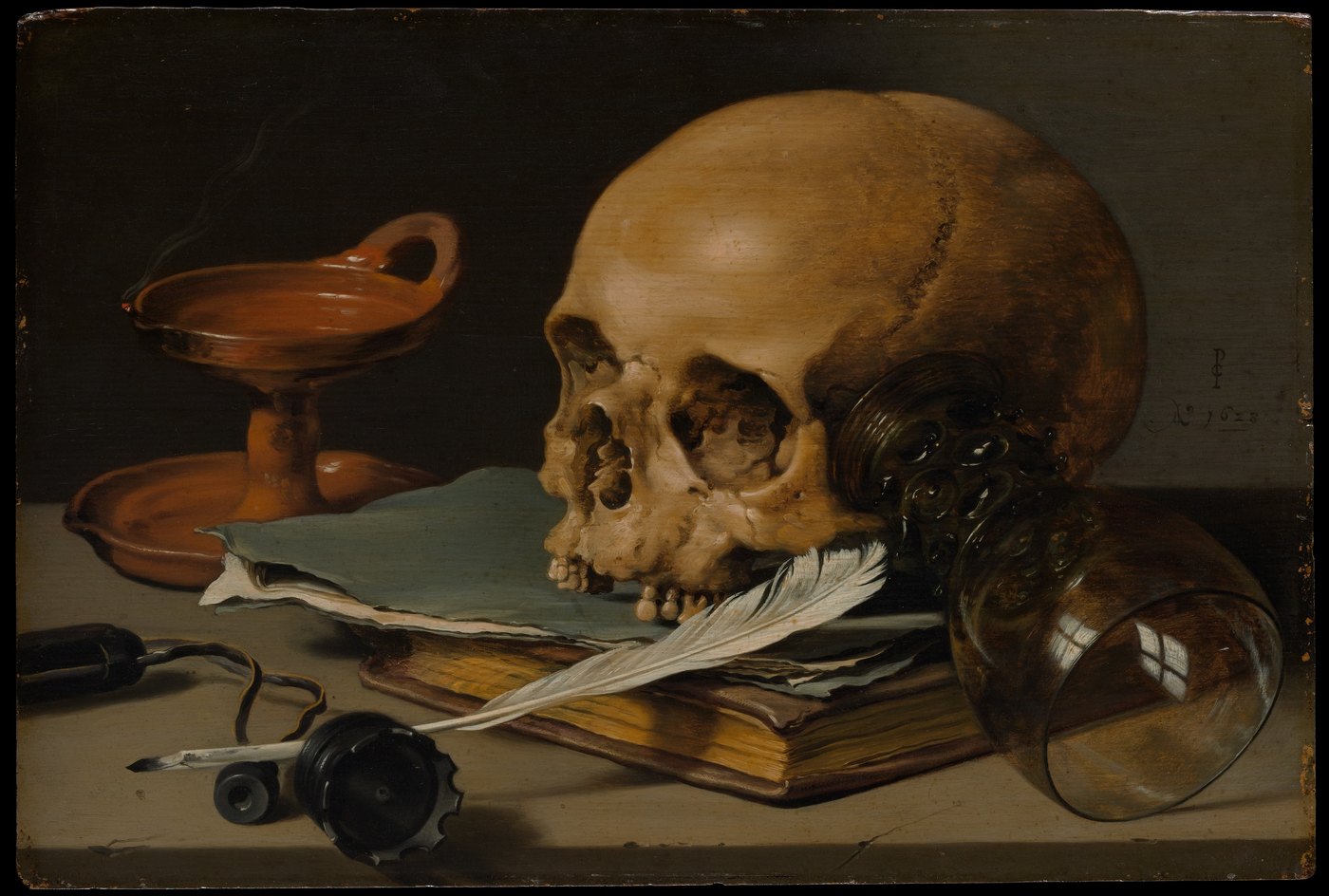
A vanitas painting is a still life arranged so that every object on the table is telling you the same thing. A skull sits among books and instruments and wine. Light falls across all of it like a shop window. Then you notice the candle has just gone out, the glass is empty, the flower is bending, and the whole beautiful arrangement turns out to be an argument about how little time you have.
What makes a still life a vanitas painting
Any still life can hold a skull. What makes it a vanitas is that the objects are chosen as a set and every one of them is about running out.
The stock vocabulary is small and repeats across hundreds of surviving pictures: a skull, soap bubbles, a burning or extinguished candle, empty glasses, wilting flowers, insects, smoke, clocks, mirrors, books, hourglasses and musical instruments. A painter could rearrange them for a lifetime and the sentence never changed.
The name comes from the opening of Ecclesiastes in the Latin Vulgate, vanitas vanitatum omnia vanitas, usually given in English as vanity of vanities, all is vanity. The older sense of vanity is closer to emptiness than to conceit.
The Leiden workshop where vanitas painting began
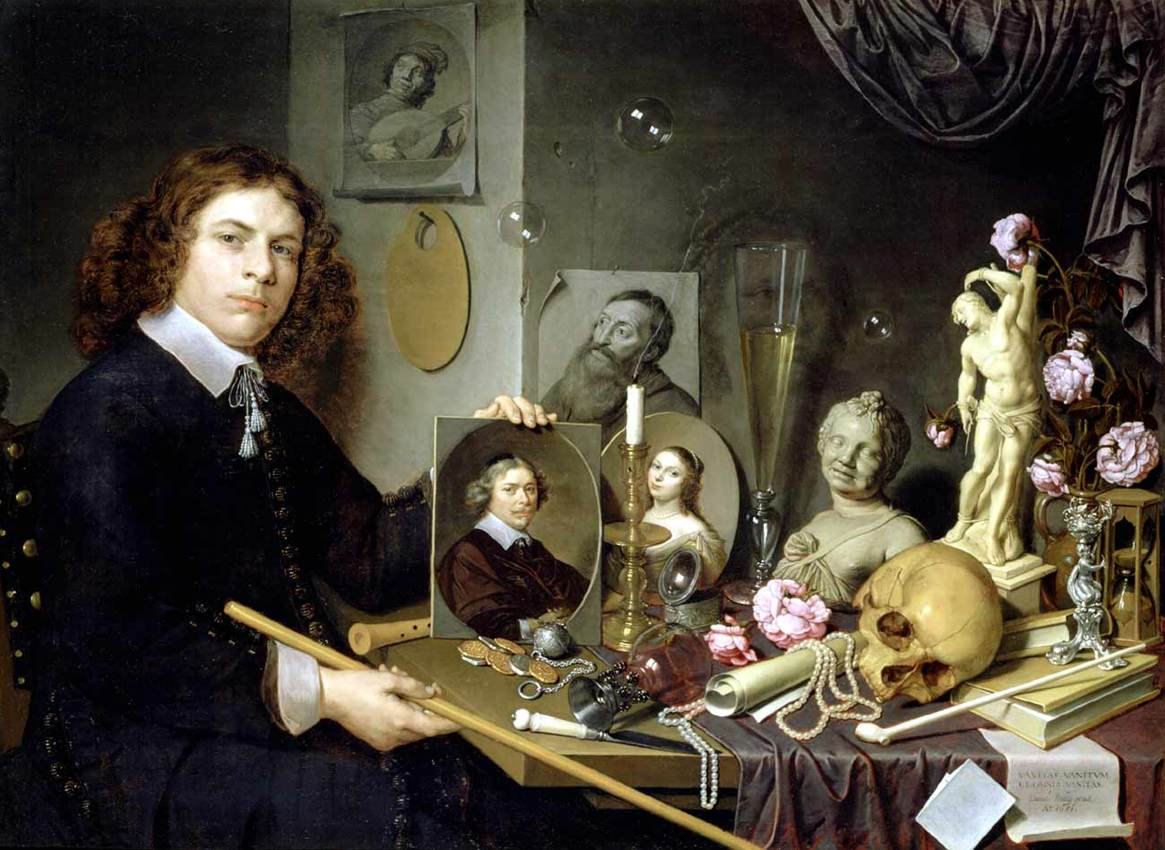
The genre has an address. David Bailly, born in Leiden in 1584, is generally credited with inventing it, and Leiden is where it stayed concentrated.
It also passed down by family. Bailly taught his nephews, and one of them, Harmen Steenwyck, became the leading painter working in it. The National Gallery in London holds Steenwyck's Still Life: An Allegory of the Vanities of Human Life, which is the version most people have seen even if they never caught the title.
So this is not a mood that drifted across Europe. It is a specific idea, taught in one Dutch town, carried by one family of painters, and then copied everywhere.
What each object in a vanitas painting means
The skull is the obvious one and it does the least work on its own. The rest of the table is where the argument gets made.
A candle just extinguished, with the smoke still rising, dates the picture to a moment rather than an era. An hourglass or a clock says the same thing with machinery. Soap bubbles are the most elegant object in the vocabulary, beautiful and already ending while you look at them.
Books and instruments stand for knowledge and skill, the things a man spends a life acquiring and cannot take. Empty glasses and overturned cups stand for pleasure already had. Wilting flowers and insects mark decay that has started but is not finished.
Mirrors are the one that implicates the viewer. The table is arranged for you, and the mirror is there to remind you that you are in the picture.
Why vanitas painting peaked in the richest country in Europe
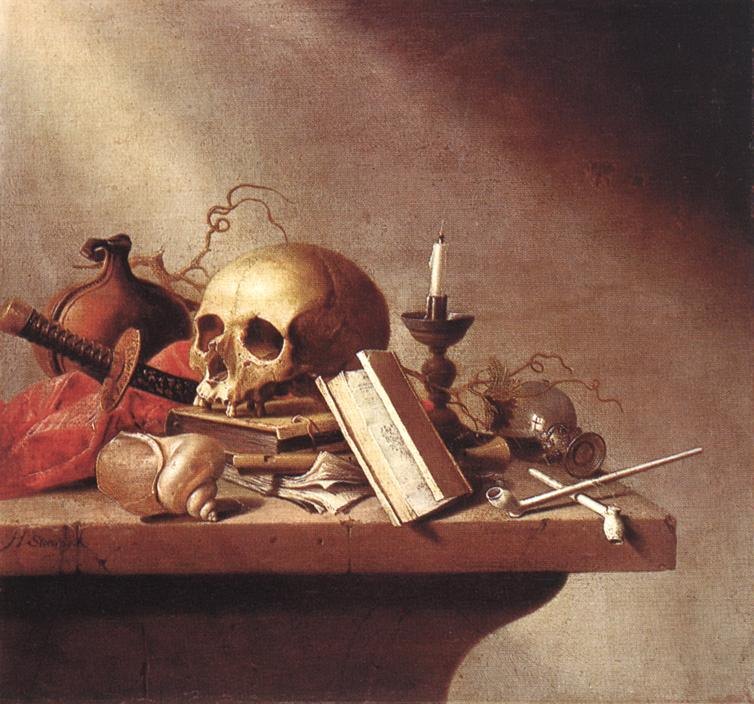
The timing is the interesting part. These pictures were produced in volume in the Dutch Republic during its Golden Age, at the point when that society had more trade, more shipping and more disposable wealth than anywhere else on the continent.
People who had very little did not commission paintings about how possessions do not last. People who had just acquired a great deal did. The genre is a rich society arguing with itself, hung in the houses of the people it was arguing with.
That is also why it reads so well now. The anxiety is specific and familiar: things are going well, and that fact itself is unsettling.
Memento mori, the phrase behind every vanitas painting
Memento mori translates as remember that you must die, and it predates Dutch painting by well over a thousand years.
The usual account traces it to the Roman triumph, where a victorious general paraded through the city with a slave or servant positioned behind him to repeat a reminder of mortality so that the day did not go to his head. The story is traditional rather than firmly documented, which is worth saying plainly, but the phrase itself long outlived the custom.
Vanitas is what happens when that sentence becomes an object. Instead of a voice behind you, a painting sits on the wall and says it every time you walk past.
Where a vanitas painting belongs on a wall today
The genre has never stopped working, it has only changed carrier. The same sentence now shows up as a tattoo, a phone wallpaper, a watch dial, and an Italian phrase on a print.
On a wall it does one specific job. It is the piece that stops you on the way past, which is why it belongs where you pass daily rather than where guests are seated. Our own version of the argument is Tutto Passa, everything passes, and it sits in the same tradition with the furniture stripped out.
Hung in an office, it is a corrective to a good quarter. Hung over a desk, it is the oldest productivity advice there is, which is that the clock is running and it was always running.
Sources
Vanitas, Wikipedia - https://en.wikipedia.org/wiki/Vanitas David Bailly, Wikipedia - https://en.wikipedia.org/wiki/David_Bailly Harmen Steenwijck, Wikipedia - https://en.wikipedia.org/wiki/Harmen_Steenwijck Harmen Steenwyck, Still Life: An Allegory of the Vanities of Human Life, The National Gallery - https://www.nationalgallery.org.uk/paintings/harmen-steenwyck-still-life-an-allegory-of-the-vanities-of-human-life Pieter Claesz, The Metropolitan Museum of Art - https://www.metmuseum.org/art/collection/search/435904
Shop the idea